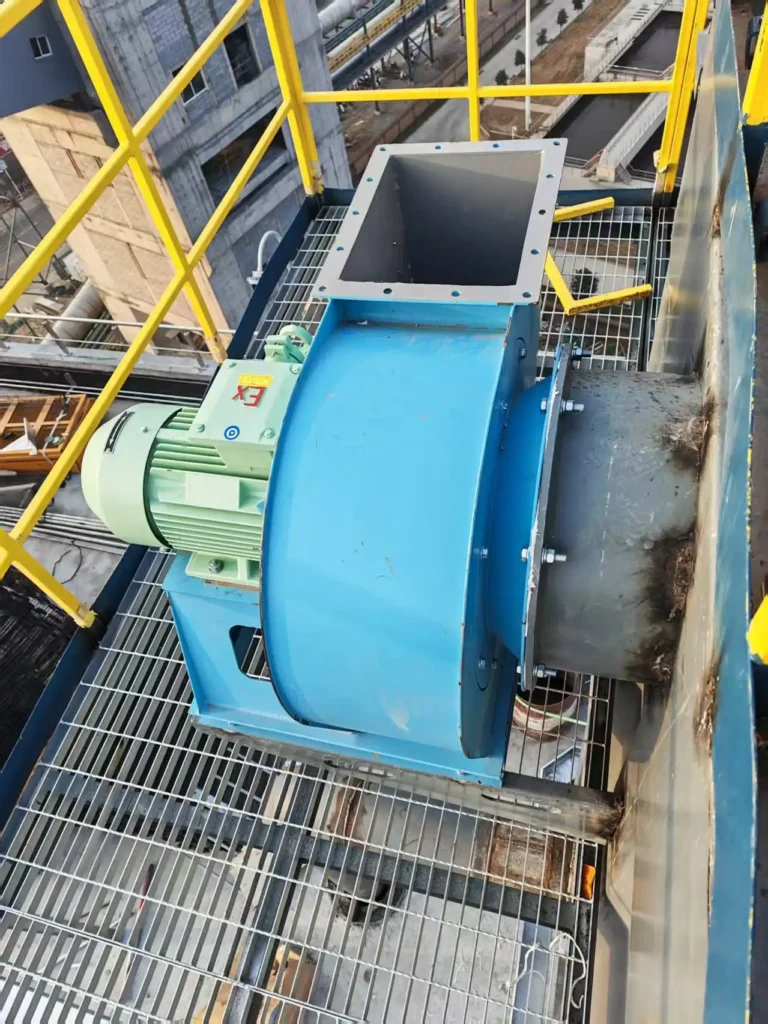
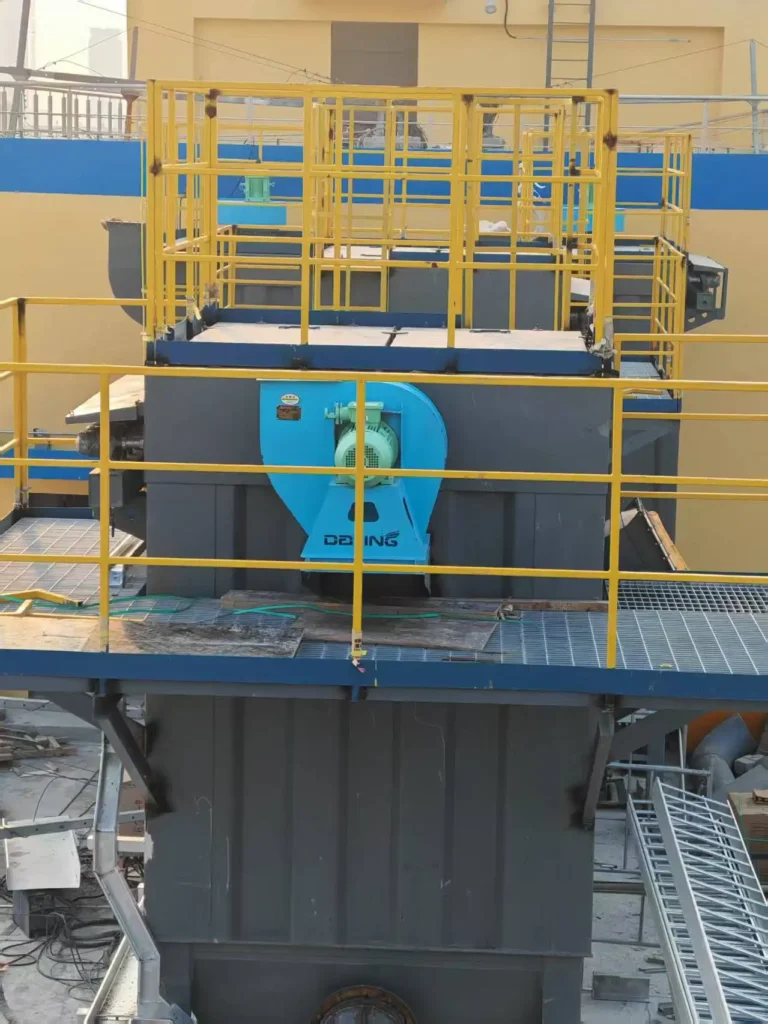
Wear-resistant centrifugal fans are specifically designed to handle harsh gas environments containing solid particulates (dust, debris, particles, etc.). Their core feature lies in the use of wear-resistant materials or processes (such as overlay welding, ceramic spraying, or high-strength steel plates) in critical components (e.g., impellers, volutes, shaft discs) to extend service life.
They are primarily applied in the following industries with high wear resistance requirements:
1. Power Generation Industry
Coal-fired power plants: The most typical application area. Used in primary fans, secondary fans, induced draft fans (especially post-flue gas desulfurization), and pulverizer exhaust fans for boilers. These fans handle flue gas containing large amounts of fly ash and unburned carbon particles, resulting in extreme wear.
2. Metallurgical Industry
Steel Mills: Used in blast furnace blowers (under certain operating conditions), sintering dust collection fans, converter gas recovery fans, blast furnace gas pressurization fans, and dust collection systems across steelmaking and ironmaking processes. The gases contain hard particles such as metal dust and iron oxide scale.
Non-ferrous Metal Smelting: Used in flue gas discharge and waste heat recovery systems during copper, aluminum, zinc, and other smelting processes. The flue gas contains metal oxide dust, causing both corrosion and wear.
3. Building Materials and Cement Industry
Cement Plants: This represents another high-demand application area. From raw material preparation, kiln head and tail sections, to clinker cooling and cement grinding, nearly all process stages require wear-resistant designs for dust extraction fans and process fans (e.g., kiln tail exhaust fans, kiln head cooling fans, coal grinding fans). This is due to extremely high dust concentrations and hard particles (such as cement raw materials and clinker powder).
4. Mining and Mineral Processing
Coal Mines: Used for mine ventilation (containing coal dust), gas drainage, and dust collection systems in coal preparation plants.
Metal and Non-Metal Mines: Employed in mineral processing plants for dust extraction fans, flotation blowers, and tailings treatment systems, where gases contain highly abrasive particles like mineral sands and rock dust.
5. Chemical and Petrochemical Industries
Used for conveying process gases containing catalyst particles, coal dust, plastic pellets, salt mist, etc. Examples include air supply for fluidized bed reactors, carbon black conveying, and PVC powder handling.
6. Waste Management and Biomass Power Generation
Waste-to-Energy Plants: Flue gases from incineration are complex, containing high levels of acidic gases and unburned ash particles, imposing extreme wear and corrosion demands on induced draft fans and forced draft fans.
Biomass Power Plants: Flue gases from burning straw, wood chips, etc., contain alkali metal salts and ash with strong abrasive and scaling properties.
7. Pulp and Paper Industry
Primarily used for induced draft and forced draft fans in biomass fuel boilers, as well as flue gas fans in alkali recovery furnaces. Flue gases may contain alkali dust and incompletely combusted particles.
8. Wood Processing and Furniture Manufacturing
Used in central dust collection systems to handle large volumes of wood chips and dust generated during sawing, planing, and sanding operations. Although particle hardness is relatively low, high concentrations and fibrous properties impose special wear requirements on fans.
Summary: Core Applications for Wear-Resistant Centrifugal Fans
Industrial sectors where process gases contain moderate to heavy concentrations of solid particulates that cause rapid wear on standard fan impellers require wear-resistant centrifugal fans.
Key Selection Criteria:
Particle Characteristics: Hardness, concentration, particle size, shape (sharp-edged particles cause greater wear).
Gas Properties: Temperature, corrosive components (whether corrosion resistance is required).
Wear-Resistant Process Selection: Based on wear severity, choose from options like impeller surface hardfacing (e.g., tungsten carbide), ceramic spraying, using wear-resistant steel (e.g., NM360, NM400) throughout, or composite materials.
Structural Design: Incorporate features to prevent particle buildup and reinforce vulnerable areas.
Therefore, clearly communicating the specific medium composition, concentration, temperature, and other operating conditions to the fan manufacturer during procurement is crucial for selecting the appropriate wear-resistant fan model.